The Flipping Theory
The Gaussian curve represents the stable equilibrium of cosmic energy flow.
feed your mind

Principle of Cosmic Energy Distribution
Traditionally, a Gaussian distribution is used to describe randomness, error, or noise. In Flipping Theory, this interpretation is inverted:
• The Gaussian curve represents the stable equilibrium of cosmic energy flow.
• The σ (sigma) boundaries are not abstract probabilities, but natural energy domains.
• Each region under the curve corresponds to an ontologically different energy manifestation.
Thus, the universe does not contain dark energy or dark matter as exotic add-ons-it expresses energy differently depending on its position within the Gaussian structure.
o-o
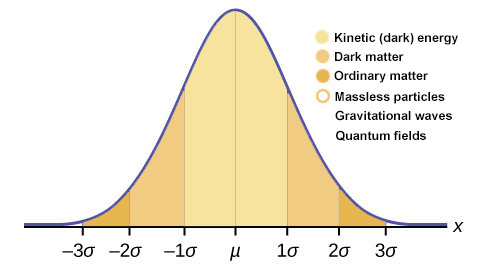
Gaussian distribution gains new meaning - distribution of energy in the universe
o-o
The Cosmic Plain Energy Distributions in Flipping Theory
An Essay
In Flipping Theory, the Cosmic Plain is not merely a geometric abstraction or a convenient averaging surface. It is a physical-conceptual zone of homogeneity where the universe reveals its most honest statistical behavior. On this plain, complexity does not vanish, but it becomes evenly distributed, allowing underlying laws to be read without the distortions imposed by local structures, observers, or historical contingencies. Energy, in this setting, does not fragment arbitrarily; it arranges itself according to a deep and intelligible order.
At the heart of this order lies the Principle of Cosmic Energy Distribution, which interprets the universe's energy content through a Gaussian framework. Unlike standard cosmology, which partitions the universe into empirically fitted categories-dark energy, dark matter, and baryonic matter-Flipping Theory derives these proportions from the intrinsic behavior of aging photons and the statistical geometry of the Cosmic Plain itself.
The Gaussian distribution is not introduced as a mathematical convenience but as a physical necessity. Photon aging, governed by a continuous Gaussian decay of frequency over cosmological time, naturally produces a bell-shaped energy profile when examined across the Cosmic Plain. The σ-intervals of this distribution acquire physical meaning: they define modes of existence rather than mere probability ranges.
Within ±1σ of the Gaussian curve lies approximately 68.27% of the total cosmic energy. In Flipping Theory, this dominant portion is identified not as dark energy, but as kinetic cosmic energy-energy of motion, propagation, and flow. It is the energy of spacetime remaining dynamically active without requiring accelerated expansion. This reinterpretation eliminates the need for a mysterious repulsive force acting against gravity. The universe does not accelerate.
Beyond this central region, between 1σ and 2σ, lies roughly 27.18% of the energy content. This region corresponds to what mainstream cosmology labels dark matter. In Flipping Theory, this energy is gravitationally effective but interaction-poor, aligning naturally with the concept of flippons-transparent, non-interacting, gravitationally defined entities. Dark matter is thus not exotic; it is simply energy displaced into a different σ-domain of the Cosmic Plain.
The familiar ordinary matter, comprising about 4.28%, resides further out in the Gaussian tail. Its rarity is not accidental but structurally necessary. Matter, in Flipping Theory, is a condensed and localized manifestation of energy, requiring precise conditions to form and persist. Its small proportion reflects the improbability-not the insignificance-of such conditions on a homogeneous cosmic stage.
Even further along the distribution lie massless particles 0.26% and gravitational waves 0.006%. These extreme tails represent energy modes that are real but marginal, detectable only with extraordinary effort or indirectly through their effects. Their existence validates the openness of the universe assumed by the Law of Last Evidence: not all energy must be measurable to be real, and not all reality must be instrument-accessible.
What distinguishes the Cosmic Plain Energy Distributions from conventional cosmological accounting is their non-arbitrariness. No parameter is tuned to fit observations after the fact. Instead, observations find their place within a pre-existing structure dictated by photon aging and statistical homogeneity. The Cosmic Plain does not adjust to the universe; the universe reveals itself upon the Plain.
Philosophically, this framework restores balance. Energy is neither hidden by ignorance nor invented to patch theoretical gaps. It is distributed according to necessity, not convenience. The Cosmic Plain thus becomes a moral as well as a physical concept-an insistence that the universe be understood where it is most fair, most even, and least distorted.
In Flipping Theory, to "not touch the Cosmic Plain" is a warning against forcing local narratives onto global reality. When respected, the Plain speaks clearly: the universe is not dominated by the unknown, but by the misunderstood. Its energy is not missing; it is correctly placed.
Krunomir with radiant light - Credit Chat GPT
o-o
The mini-novel "Flippon" is the oldest source of information about the Flipping Theory..