The Flipping Theory
Elementary particles of ordinary matter have been created by crushing flippons.
feed your mind

Flipping model of elementary particles
The Standard Model of elementary particles is limited to the microcosm. The Macrocosm and physics of large scale are not covered. Fortunately, Flipping Theory opens up new possibilities. To obtain the Flipping model of elementary particles, one should add the flippon as a new particle to the Standard model of elementary particles (see the picture below). You must agree that this is a simple but significant change.
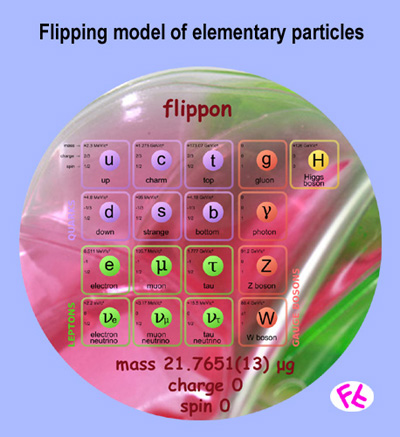
Flipping model of elementary particles
Flippon is a huge, massive particle generated by a flipping transformation from the space of property to our space, the space of reality. The transformation is caused by "goo-collision" between fluctuating "length-time" and "mass-length" goos. The process of forming flippons is accompanied by generating mass and space, and can be described by the Incipient Law of Creation. Flippons have a mass of 21.7651 ug, a volume of 2.198x10¹⁸ m3 (approximate diameter ~1613 km), and generate a minimum quant of time of tF=5.39106x10-44 s. Flippons carry no electrical charge and do not interact via the weak or strong nuclear forces. Flippons are mutually transparent, do not collide, and do not bounce off one another or ordinary matter. Furthermore, they are utterly transparent, with no friction or viscosity, and behave almost like empty space. Flippons interact only through gravity. It is assumed that flippons do not spin.
At the moment of creation, flippons use three basic processes: summation of mass, summation of volume, and time flow. After formation, under the influence of gravity, flippons are being accumulated into the dark matter clouds. There are two types of clouds, flipptant and flippmint. Flipptants are clouds with a large presence of flippons, which can trigger a new process called massaggregation - generating elementary particles. Flippmints are small clumps of dark matter from which ordinary particles can not arise.
Temperature of the Flippon
In classical physics, temperature is an emergent concept. It is not a property of an individual object, but a statistical measure of collective motion-of countless particles exchanging energy through collisions and interactions. From this perspective alone, the question "What is the temperature of a flippon?" already hints at a conceptual boundary. The flippon, as introduced in Flipping Theory, resides precisely at such a boundary: it is real, massive, gravitationally defined, yet fundamentally non-interacting. Its temperature, therefore, cannot be treated in the ordinary thermodynamic sense.
A flippon does not collide, does not vibrate, does not rotate, and does not exchange energy through electromagnetic or nuclear forces. It is transparent, inert, and isolated except for gravity. Consequently, the classical mechanisms by which temperature arises-random kinetic motion and thermal equilibration-are absent. In this strict physical sense, the flippon has no temperature. Or more precisely, temperature is undefined at the level of a single flippon.
However, this absence is not a weakness of the concept; it is a clue to a deeper structure of reality.
In Flipping Theory, flippons are born through the Incipient Law of Creation, a continuous mass-energy flow from the intergalactic vacuum mediated by black holes. This process is governed not by thermal chaos but by fundamental limits expressed through constants such as Ik = c3/G and the minimal time quantum tF. The creation of flippons is not a thermal event; it is a structural one. It does not heat space-it defines space.
Temperature, in contrast, appears later. It emerges only when flippons self-fragment and reorganize into interacting particles capable of motion, collision, radiation, and entropy production. Only at that stage-when electromagnetic charge, spin, and interaction channels arise-does temperature become meaningful. Thus, temperature is not fundamental; it is derivative. Flippons exist prior to temperature, just as spacetime exists prior to clocks.
One might ask whether a flippon could be assigned an effective temperature via gravity, in analogy with black hole thermodynamics. Yet even here the analogy fails in an instructive way. Black holes possess entropy and temperature because they represent horizons-interfaces between observable and unobservable degrees of freedom. A flippon, by contrast, is not a horizon but a volume. It hides nothing; it simply does not participate. Gravity defines its mass, but gravity alone does not thermalize.
In this light, the temperature of a flippon can be described only negatively: it is not hot, not cold, not warm, not frozen. These words belong to a language that presupposes interaction. The flippon is thermally silent. It carries mass without agitation, energy without noise.
This thermal silence has profound cosmological implications. If dark matter is composed of flippons, then its "coldness" is not merely a low temperature in the conventional sense but an absence of temperature altogether. Dark matter is not cold because it has equilibrated to a low thermal state; it is cold because it never entered the thermal game. It does not cool-it simply does not heat.
Seen this way, the flippon represents a pre-thermodynamic layer of reality. Temperature emerges only after flipping has progressed far enough to permit interaction. Before that, there is structure without warmth, mass without motion, existence without thermodynamics.
Thus, the correct answer to the question "What is the temperature of a flippon?" is neither a number nor a limit. It is a statement of principle: the flippon has no temperature, because it belongs to a realm of physics where temperature has not yet been invented.

The Solitary Flippon - artwork by Krunomir
o-o
The mini-novel "Flippon" is the oldest source of information about the Flipping Theory.