The Flipping Theory
Only photons know what is tiredness. We can measure it.
feed your mind

Law of Aging Photons
It is widely known that photons are the gauge bosons of electromagnetism. They are oscillating discrete bundles (packets) of electromagnetic energy. Whenever charged particles interact, photons are exchanged. They have no mass, no electric charge, no weak charge, and no color charges. Photons are always in motion. They travel at a constant velocity through a vacuum at the speed of light for all observers. Photons are currently best explained by quantum mechanics and wave-particle duality. They exhibit wave or corpuscular properties. For example, a single photon may be refracted by a lens or show wave interference with itself. Also, photons act as particles, yielding definite results when their positions are measured.

It appears that an expanding and accelerating universe is a consequence of insufficient knowledge about the properties of light, as well as the misinterpretation and misuse of the Doppler effect. This cognition is changing the cosmology and history of the universe... Oh my, I'm in big trouble - Krunomir.
As a discrete pocket of oscillating electromagnetic energy, photon has its own frequency, which determines the energy of photon E = hν. Emitted photons from distant objects lose energy on the way. It is manifested through the decrease of photon frequency by Law of Aging Photons:
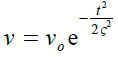
Where is ς the photon aging constant (6.011048×10^7 s or 19.04828 billion years). Farther objects give us photons with a lower frequency. The farthest objects give us the microwave radiation. This process is continuous, and there is nothing discrete about it. Only a hard stops of photons show discrete phenomena. The cognition of aging and continuity of photon energy is a turning point between the classical and quantum worlds. The door is ajar for many explanations of the physical world.
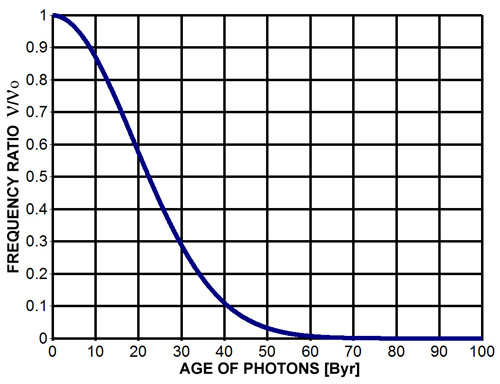
Diagram of the Law of Aging Photons
Essay on the Law of Aging Photons
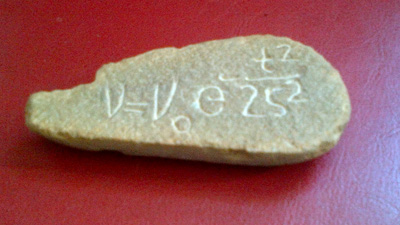
Law of Aging Photons-set in stone.
The Law of Aging Photons proposes a simple but radical idea: photons are not timeless messengers. Even in perfect vacuum, uninterrupted by matter or interaction, a photon gradually ages. This aging is not decay in the classical sense, nor energy loss through scattering or absorption, but a continuous, intrinsic transformation of the photon’s frequency over cosmic time. Within the framework of the Flipping Theory, this law offers an alternative interpretation of one of cosmology’s most fundamental observations—cosmic redshift—without invoking universal expansion as its primary cause.
At the heart of the law lies a rejection of an implicit assumption deeply embedded in modern physics: that a freely traveling photon preserves its energy indefinitely. While conservation laws are rigorously enforced in local interactions, the Law of Aging Photons questions whether such conservation must hold globally and eternally, especially across cosmological timescales. A photon emitted billions of years ago may still exist, but it is no longer the same photon in energetic terms. Time, even in emptiness, leaves a trace.
In this view, redshift becomes a temporal phenomenon rather than a purely kinematic one. Light from distant galaxies appears redshifted not because space itself has stretched, but because the photons have aged during their long journey through the Cosmic Plain—a statistically homogeneous, interaction-poor domain where aging proceeds smoothly and universally. The greater the travel time, the greater the frequency shift. Distance and redshift remain correlated, but causality is reassigned: time replaces expansion as the dominant driver.
Mathematically, photon aging is described not as a stepwise or exponential decay, but as a continuous Gaussian process. The photon’s frequency evolves according to a bell-shaped decay function, governed by a characteristic aging constant derived from fundamental cosmic parameters. This formulation is significant: Gaussian behavior implies smoothness, stability, and the absence of abrupt transitions. Aging is not catastrophic; it is gentle, symmetric, and deeply connected to the background energy density of the universe. Discrete effects appear only when photons are interrupted—absorbed, scattered, or measured—but never during uninterrupted propagation.
This reinterpretation has profound implications for cosmology. If redshift is primarily an aging effect, then the need for dark energy as an expansive driver is substantially reduced or eliminated. What is currently attributed to accelerated expansion may instead reflect the statistical outcome of photon aging across vast temporal baselines. The universe can remain globally non-expanding, or only weakly dynamic, while still producing the precise redshift-distance relationships observed in astronomical surveys.
The Law of Aging Photons also restores a subtle symmetry between matter and radiation. Matter ages through entropy, decay, and structural transformation. Why should radiation be exempt? In Flipping Theory, photons are not eternal Platonic entities but participants in cosmic evolution. Their aging mirrors the universe’s continuous redistribution of energy, aligning radiation with the broader Principle of Cosmic Energy Distribution.
Philosophically, the law challenges the notion that emptiness is inert. Even in vacuum, time acts. Space is not merely a stage on which photons glide unchanged; it is a medium of duration, imprinting age without resistance. This idea resonates with the Law of Last Evidence: what ultimately disappears is not only matter, but measurable distinction itself. Photon aging is one such fading—slow, lawful, and detectable only statistically.
Importantly, the Law of Aging Photons does not deny established observations; it reinterprets them. It respects the empirical success of redshift measurements, the cosmic microwave background, and large-scale uniformity, while offering a different causal narrative. In doing so, it invites cosmology to reconsider whether expansion is an observed fact or an inferred assumption.
In essence, the Law of Aging Photons reframes light as a clock. Every photon carries not only information about its source but also the imprint of its own journey through time. Redshift becomes a memory of duration rather than motion. The universe, seen through this lens, is not rushing apart but slowly, continuously aging—quietly transforming signal into softness, blue into red, youth into history.
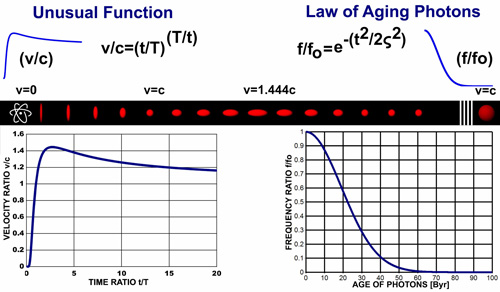
Unusual Functio and Lawof Aging Photons - Topic for future discussions.
o-o
The mini-novel "Flippon" is the oldest source of information about the Flipping Theory.