The Flipping Theory
The mass of real space constantly flows with the mass rate of 4.037×10^35 kg/s..
feed your mind

Incipient Law of Creation
The general idea is to create a new frame of reference for the smooth continuous nonviolent creation wich accepts a birth, growth and evolution of our reality.
In physics, Planck units are physical units of measurement based on the five universal physical constants: speed of light in a vacuum c, gravitational constant G, reduced Planck constant ħ, Coulomb constant ke, and Boltzmann's constant kB. All of them are related with at least one fundamental physical theory, such as: Newtonian gravity, special and general relativity, quantum mechanics, electrostatics, statistical mechanics and thermodynamics. The first three of these constants (c, G, and ħ) are sufficient to define the Planck length, Planck time, and Planck mass.
It is possible to combine Planck units to produce many new units. Look at the picture "The six fingers interpretation". On the right side are the well-known Planck units. On the left side of the picture are new units relevant to the Flipping theory and Incipient Law of Creation. They possess special properties and have a physical meaning. For more details, read the mini-novel "Flippon" and the article "Incipient Law of Creation."
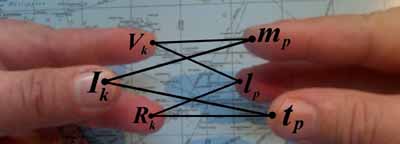
The six fingers interpretation
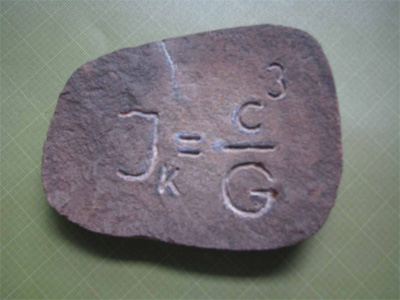
Incipient Law of Creation (previous name Ohm's Law of the Universe) written in stone by Krunomir Dvorski
Essay on the Incipient Law of Creation
The Incipient Law of Creation stands at the foundation of the Flipping Theory as its generative engine-the quiet, continuous origin of mass, space, and time. Unlike cosmological models that begin with a singular, violent event, this law proposes creation as an ongoing process, unfolding everywhere and always, without rupture or explosion. Creation, in this view, is not a historical accident but a permanent condition of the universe.
At its core, the Incipient Law of Creation asserts that the universe is not a closed system. Mass and spacetime do not merely rearrange preexisting ingredients; they continuously emerge from what appears to be emptiness. The intergalactic vacuum is not inert or passive-it is the most active region of the cosmos. From this vacuum, energy flows, governed by a universal rate defined by the constant

a quantity known in conventional physics as Planck power. In Flipping Theory, however, this is not simply a dimensional curiosity; it is the cosmic current that drives creation itself.
This law reframes black holes. Rather than being ultimate sinks of matter and information, black holes function as catalytic gateways in the creative cycle. They convert kinetic energy into potential energy, producing flippons-transparent, non-interacting, gravitationally defined entities that serve as the primordial building blocks of all particles. Flippons do not carry charge, spin, or force except gravity. They are not observed directly, yet they define the critical density of the universe and anchor the emergence of structure. Their role is subtle but essential: they allow creation to proceed without violating locality or tearing spacetime apart.
The Incipient Law of Creation also introduces three foundational constants (Ik, Vk, and Rk) which together form an analogy to Ohm's law:

Here, current, voltage, and resistance are not electrical but cosmological. Ik represents the mass-time flow of creation, Vk the mass-length potential, and Rk the length-time limitation. These are not particles nor relativistic effects; they are deep structural constraints of reality, expressing how creation is regulated rather than how it explodes. The universe, in this sense, is not powered by a bang but by a balanced circuit.
A crucial philosophical implication of the Incipient Law of Creation is its non-violent nature. There is no primordial singularity, no infinite temperature, no breakdown of physical meaning. Creation proceeds gently, continuously, and lawfully. Time does not begin at a point; it is renewed at every moment. Space is not stretched from nothing; it is generated where conditions allow it to exist. This perspective avoids the metaphysical burden of "first cause" while remaining deeply physical.
The law also complements the Flipping Theory's treatment of cosmic evolution. Because creation is continuous, large-scale uniformity does not require an expanding universe. The Cosmic Plain-a zone of statistical homogeneity-emerges naturally as creation proceeds evenly across intergalactic space. Observed phenomena such as redshift are then interpreted not as evidence of spatial expansion, but as consequences of processes like photon aging, unfolding within a universe that is dynamically steady yet creatively alive.
In this framework, conservation laws are not denied but recontextualized. They apply locally, within the domain of detectable interactions. The Incipient Law of Creation operates at the boundary where detectability ends and existence begins. It does not violate known physics; it completes it by acknowledging that reality may be open where our instruments are finite.
Ultimately, the Incipient Law of Creation is both a physical proposal and a philosophical stance. It suggests that existence is sustained by continuity rather than catastrophe, by flow rather than origin myth. The universe is not something that was made once-it is something that is being made, quietly and persistently, at every scale. In the Flipping Theory, this law is not an appendix to cosmology; it is its heartbeat.

Krunomir - In moments of active vacation in the Caribbean.
o-o
The mini-novel "Flippon" is the oldest source of information about the Flipping Theory.