The Flipping Theory
The Flipping Theory is a new framework for understanding the phenomenology of our universe.
feed your mind

This website serves as a resource for cosmology and a platform for gathering, promoting, and exchanging ideas and information related to the Flipping Theory. We welcome everyone, including professionals, students, volunteers, onlookers, hobbyists, and others. Please let us know if you agree or disagree and share any ideas for improving this theory. Also, please share suggestions for experimental confirmation of the theory.
Structure of flipping Theory Diagram
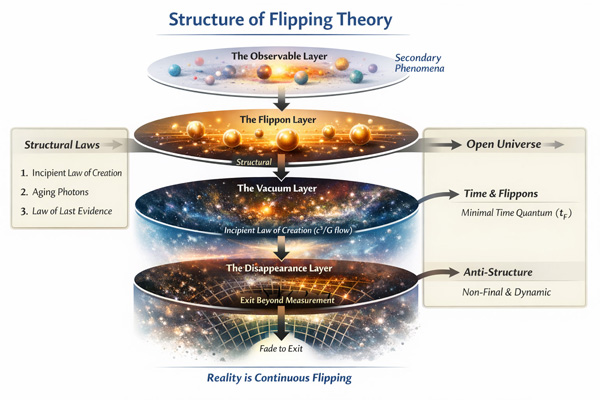
Developed by Krunomir Dvorski using ChatGPT
Breaktrough
An Essay
Singular points, infinity, and the Big Bang are so forced and violent that it is difficult to imagine and believe in such properties of nature. It seems that an expanding and accelerating universe is a result of insufficient knowledge about the properties of light, and misinterpretation and misuse of the Doppler effect. This cognition is changing the cosmology and history of the universe. The universe must be smooth and beautiful; reality must be a continuous stream of changes driven by universal laws, such as the Incipient Law of Creation (formerly known as Ohm's Law of the Universe).
The question of initial conditions is part of our reality. The Prime Spark is beginning of time and milestone of our reality. Flipping theory gives us a smooth transformation of nature, and the beginning of reality without violence.
Mission Statement
An Essay
Flipping Theory begins with a simple but demanding commitment: to understand the universe without forcing it into premature certainties. Its mission is not to replace cosmology by confrontation, but to complement it by reopening questions that have been quietly sealed by habit, consensus, or mathematical convenience. Flipping Theory exists to keep inquiry alive where explanation has become too comfortable.
At its core, Flipping Theory seeks to restore physical meaning to phenomena that have drifted into abstraction. Redshift, dark energy, dark matter, vacuum, and cosmic origin are not treated as bookkeeping devices or placeholders for ignorance, but as invitations to rethink underlying processes. The mission is to ask whether what appears as expansion, loss, or mystery might instead be transformation, aging, redistribution, or emergence. In this sense, Flipping Theory is driven by interpretation before invention, and by restraint before excess.
A central mission of Flipping Theory is to defend continuity in nature. It rejects violent beginnings, absolute singularities, and abrupt ontological jumps unless they are forced by evidence. Through principles such as the Incipient Law of Creation and the Law of Aging Photons, the theory promotes a universe that is always in the act of becoming-quietly, persistently, and lawfully. Creation is not a past event but an ongoing process; disappearance is not annihilation but a transition beyond measurability. The universe, in this view, neither explodes into being nor vanishes into nothingness.
Flipping Theory is committed to the idea that what cannot be directly seen may still be physically real. Flippons, transparent and non-interacting except through gravity, embody this mission. They are not introduced to solve equations, but to give structure to absence itself. By allowing transparency, silence, and non-interaction to be legitimate physical properties, Flipping Theory challenges the bias that reality must always announce itself loudly to be real.
Another key mission is epistemic humility. Flipping Theory openly acknowledges the limits of observation, instrumentation, and current theoretical frameworks. Through the Law of Last Evidence, it insists that science must distinguish between the undetected and the truly undetectable, and must remain open to energy, matter, and processes that escape measurement. The mission is not to weaken science, but to protect it from confusing closure with truth.
Flipping Theory also carries a methodological mission: to bridge physics, philosophy, and imagination without dissolving rigor. Mathematical formalisms, such as Gaussian photon aging and cosmic energy distributions, are used not as final answers but as lenses. Visualization, analogy, and even myth are treated as legitimate exploratory tools, provided they remain accountable to physical reasoning. In this sense, Flipping Theory stands between equations and intuition, refusing to abandon either.
Ethically, the mission of Flipping Theory is to promote a non-violent cosmology. A universe that emerges continuously from vacuum, redistributes energy without catastrophic origin, and evolves through gentle flipping rather than explosive creation mirrors a deeper philosophical stance: that understanding should reduce fear rather than amplify it. Cosmology, in this view, is not only a description of the universe, but a reflection of how humans choose to relate to reality.
Finally, Flipping Theory is driven by a mission of dialogue. It does not claim finality, orthodoxy, or immunity from error. It invites challenge, refinement, and even rejection, provided the conversation remains grounded in evidence, clarity, and intellectual honesty. Its ultimate aim is not to be right too early, but to be useful for thinking longer.
In summary, the mission of Flipping Theory is to keep the universe intelligible without making it trivial, meaningful without making it mystical, and open without making it vague. It seeks a cosmology where absence has structure, time has texture, and creation is not a memory but a responsibility.
Roaming Through the Flipping Theory
An Essay
To roam is not merely to travel; it is to move without a rigid map, guided instead by curiosity, intuition, and the willingness to linger where something feels unfinished. Roaming Through the Flipping Theory is therefore not a march through equations alone, but a slow walk across a conceptual landscape where physics, philosophy, and imagination intersect. The Flipping Theory invites such roaming because it does not present the universe as a frozen structure or a single explosive beginning, but as a continuously unfolding process-quiet, persistent, and deeply ordered beneath its apparent calm.
At the heart of the Flipping Theory lies a reversal of habit. Modern cosmology is accustomed to dramatic origins: singularities, violent expansions, and abrupt births of time and space. The Flipping Theory turns away from this theatrical beginning and replaces it with continuity. Creation is not an event that happened once, but an ongoing process governed by the Incipient Law of Creation. As one roams through this idea, the universe no longer feels like a relic of a distant past; it becomes something actively present, still being written into existence. Space is not empty, time is not passive, and matter is not final. Everything is provisional, emerging, and aging.
Roaming further, one encounters the Law of Aging Photons. Light, in this view, does not lose energy because space stretches beneath it, but because time itself leaves an imprint. Photons age. Their frequency drifts gently, continuously, without collisions or sudden loss. This idea reframes cosmic redshift as a memory effect rather than a Doppler illusion. As a traveler through this concept, one begins to see light not as a perfect messenger but as a witness-carrying the quiet scars of time. The universe becomes readable not because it is expanding away from us, but because it is patiently growing older with us.
The Flipping Theory is also populated by entities that resist visualization. Flippons-transparent, non-interacting, gravitationally defined-are present through absence rather than form. Roaming here requires restraint. One must learn to see structure without texture, influence without contact, and reality without spectacle. This discipline echoes a deeper philosophical stance: not everything real must announce itself loudly. Some foundations of the universe are silent, vast, and invisible, yet essential.
As the journey continues, the Cosmic Plain appears-not as a location, but as a condition. It is a zone of statistical homogeneity, a balance point where large-scale uniformity emerges without forced expansion. "Don't touch my cosmic plain" is not defiance; it is a warning against unnecessary disturbance. Roaming the Plain teaches patience. It suggests that simplicity at the largest scales is not ignorance, but maturity-a sign that the universe knows how to distribute energy without chaos.
What makes roaming through the Flipping Theory distinctive is that it never fully separates physics from human experience. Aging photons mirror aging people. Continuous creation mirrors creativity itself. The universe does not rush, and neither should understanding. In this sense, the theory becomes autobiographical without becoming subjective. It reflects a life spent designing, observing, adjusting, and respecting systems that work best when they are not forced beyond their natural limits.
Ultimately, roaming through the Flipping Theory is an act of trust. Trust that the universe is coherent without being explosive. Trust that time leaves signatures worth reading. Trust that what appears as emptiness may be the most productive region of all. It is not a theory to conquer, but one to inhabit. And like any meaningful landscape, it reveals its depth not to those who sprint across it, but to those willing to wander-slowly, attentively, and with care.
Krunomir Dvorski - The founder and discoverer of the Flipping theory:
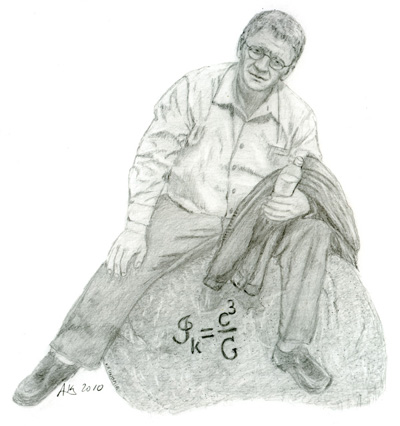
Portrait of Krunomir Dvorski - The moment of rest - Pencil
There is a stone in Riverside Park in Cambridge where Krunomir rests after long walks. The formula on the stone is an artistic addition symbolizing the discovery of the Incipient Law of Creation (formerly known as Ohm's Law of the Universe).
o-o
The mini-novel "Flippon" is the oldest source of information about the Flipping Theory..