The Flipping Theory
Force of origin is the force that resists the removal of energy from the place of origin.
feed your mind

Law of Abandonment Origin - Entanglement and Aging Photons
The generated photons are accompanied by the forces of origin that extract energy from them and prevent them from leaving. Because the speed of light is constant, photons lose energy by lowering their frequency. The remaining energy reveals information about the origin and age of photons. This process was described by the Law of Aging Photons.
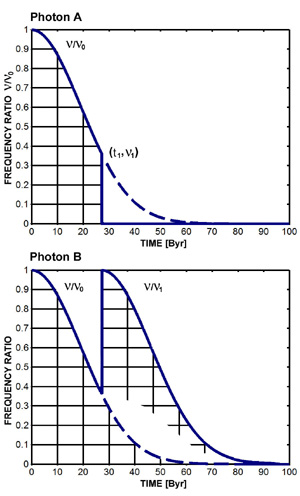
Entanglement and Law of Aging Photons
The couple of entangled photons, A and B (see figure), follow the same rule (Law of Aging Photons). Their frequency and age are the same. At the moment t1, the frequency of both photons is ν1. If a photon A at the moment t1 loses all energy (frequency jumps to zero), the entangled photon B will feel it in a spectaculary. Photon B will abandon his origin and begin a new life from frequencies ν1. In other words, the destruction of photon A does not destroy entangled photon B. Photon B breaks its relationship with photon A and continues its journey associated with a new origin and new age profile (ν /ν1). This spectacular phenomenon is called the Law of Abandonment Origin, in which instantaneous entanglement violates causality. The violation can be used for establishing and measuring hidden variables of entangled photons...
Essay on the Law of Abandonment Origin – Entanglement and Aging Photons
In the architecture of the Flipping Theory, the Law of Abandonment Origin occupies a subtle but essential position. It does not speak about creation in the loud sense of beginnings, nor about destruction in the dramatic sense of endings. Instead, it addresses a quieter transition: the moment when a physical relationship loses its origin, not by force or rupture, but by aging, separation, and irreversible weakening of coherence. When applied to quantum entanglement and aging photons, this law offers a unifying perspective that bridges quantum behavior, cosmological observation, and temporal asymmetry.
At its core, the Law of Abandonment Origin states:
Every interaction carries an origin, but not every origin remains accessible forever.
What is abandoned is not existence itself, but relational memory—the ability of a system to reference its point of mutual definition.
Origin as Relation, Not Location
In conventional physics, origin is often treated geometrically: a point in space, a moment in time, an event. In the Flipping Theory, origin is instead relational. Two particles are said to share an origin if their properties are defined through a common act of emergence or interaction. Quantum entanglement exemplifies this perfectly: two particles, once interacting, share a correlated state that cannot be decomposed into independent descriptions.
However, the Law of Abandonment Origin asserts that origin is not permanent. It is maintained only so long as the physical carriers of relation preserve coherence. When the carriers age, disperse, or weaken, the origin does not disappear abruptly—it fades.
Entanglement as a Young Relationship
Entanglement is often described as timeless or nonlocal, but this description hides an implicit assumption: that the entangled carriers do not age. In practice, entanglement is fragile. It decoheres under environmental interaction, noise, and—most importantly in this context—time.
Within the Flipping Theory, entanglement is interpreted as a low-age relational state. The particles are still “close” in informational age, even if spatially distant. Their shared origin remains active because the photons or mediating fields that maintain correlation have not yet lost coherence.
As photons age, however, their frequency declines according to the Law of Aging Photons. This aging is continuous, smooth, and Gaussian in nature—not discrete, not catastrophic. As frequency declines, so does the photon’s capacity to preserve precise phase relationships. Since entanglement relies on phase and correlation, aging photons gradually lose the ability to maintain entanglement.
Thus, entanglement is not broken—it is abandoned.
Aging Photons as Carriers of Abandonment
Photons are not timeless messengers. In the Flipping Theory, they are temporal entities, subject to aging just as all physical carriers are. Their aging manifests as redshift without requiring cosmic expansion. But beyond observational cosmology, photon aging has a deeper implication: it limits the lifespan of relational information.
An aging photon can still exist, still propagate, still interact—but it no longer faithfully carries its original relational imprint. The correlation becomes smeared, then statistically irrelevant. When this happens, the system no longer has access to its shared origin.
This is the precise moment governed by the Law of Abandonment Origin:
• No signal announces the loss.
• No boundary marks the transition.
• The origin simply ceases to be operational.
Abandonment Without Destruction
A key philosophical strength of the Law of Abandonment Origin is that it avoids violent metaphors. There is no “collapse” of reality here, no sudden death of connection. Instead, there is a graceful withdrawal.
This distinguishes abandonment from:
• Decoherence, which is often treated as an external disruption,
• Measurement collapse, which introduces observer-centric assumptions.
Abandonment is neither external nor observer-dependent. It is intrinsic to the aging of physical carriers. The universe does not sever connections; it allows them to fade naturally as energy redistributes and coherence disperses.
Temporal Asymmetry and the Arrow of Origin
The Law of Abandonment Origin also provides a natural explanation for temporal asymmetry. Time moves forward not because of entropy alone, but because origins cannot be refreshed without new creation. Once an origin is abandoned, it cannot be re-accessed unless a new relational event occurs.
his aligns seamlessly with:
• The Incipient Law of Creation, which continuously introduces new relations,
• The Law of Last Evidence, which defines reality by what can still be measured.
Between these laws, the Law of Abandonment Origin acts as the bridge: explaining why the past becomes unreachable even though its products persist.
Cosmological and Philosophical Implications
On cosmological scales, this law suggests that the universe is filled with abandoned origins—ancient correlations that once existed but no longer influence present structure. What we observe is not the full history of reality, but the survivable fraction of coherence.
Philosophically, this reframes loss not as absence, but as completed relation. Something existed, mattered, interacted—and then gently let go. The universe remembers nothing forever, not because it is forgetful, but because memory itself requires energy, coherence, and youth.
Conclusion: A Universe That Lets Go
The Law of Abandonment Origin teaches us that the universe is not built on permanence, but on transition. Entanglement is a youthful bond. Photons are aging messengers. Origins are real, but not eternal.
In allowing origins to be abandoned rather than destroyed, the Flipping Theory presents a cosmos that is neither mechanical nor cruel, but balanced—constantly creating, continuously aging, and gracefully releasing what can no longer be held.
In this sense, abandonment is not failure.
It is the universe making room for what comes next.
o-o
The mini-novel "Flippon" is the oldest source of information about the Flipping Theory.